
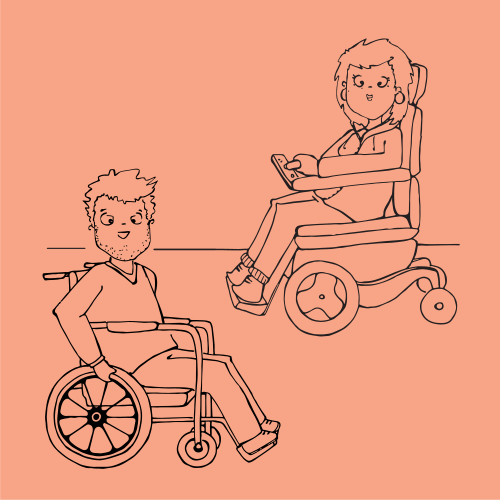
WHEELCHAIR USERS: Manual & electric
For people like myself, using electric or manual wheelchairs for mobilization, the challenge starts from the moment they leave their familiar personal environment. My home is adapted to my personal needs in as far as it needs to be. I can move independently and enjoy my hobbies to the full. At home, I do not notice my own disability as much. I am enabled by my private environment much more than I am disabled by it. Outside, though, it’s a different story. My disability becomes much more noticeable because of a lacking environment, one that is not sufficiently adapted to different needs. Because of this fact, I need to plan my entire trip upfront when I want to go out. I need to be sure that there is sufficient space for me and my wheelchair and that the necessary adaptations were made.
And before I can even think of going anywhere, I need to check if I can reach it. When I need to go a longer distance, I usually go by car. Usually, there is someone accompanying me at that moment because he or she needs to assist me. Sometimes, we need to unload the car from the side and that’s when small parking spaces start causing a real and frustrating problem. For many wheelchair users, reaching a shop, public place or building could be a real issue when they rely on suitable parking spaces that are wide enough and close enough to their destination. My car is still more reliable than public transportation, though. The train, bus or metro services are not always easily reachable or accessible to me. For example, most stops are below the level of the floor of the bus, so no way to enter the bus with my wheelchair.
Entering buildings is another issue for me. What I am noticing, is that reaching public places has become a little bit easier over time. Ramps, flattened curbs and slopes are additions that are becoming more common nowadays. However, sometimes they are too steep for me and not all of them have resting places for me to catch my breath. Sometimes, I even need to enter a building from a completely different side as the main entrance, simply because the slope runs toward a separate entrance especially built for disabled persons. But I do not enjoy designated entrances or special treatments that draw attention to my needs even more. I would like to feel more included by being able to go and to do the same things as everyone else.
After having reached a place, comes the challenge of trying to enter it. Mostly, as I try to enter buildings, or the smallest places in those buildings, I encounter more and more difficult thresholds. Smaller, local shops and buildings are the most difficult for me because the public infrastructure is usually a lot older and far less adapted to specific needs. But even newer buildings, such as modern shopping centers, are not entirely available to me. Most shopping centers I visit are pretty reachable as such, but once I am there I experience thresholds when I try to enter shops or try to navigate those shops. I encounter many physical thresholds such as doorsteps, shop entrances, and when trying to enter public buildings and spaces. Narrow paths and door openings limit my movements. The space that I need to turn my wheelchair or to swing the door open has often not been taken into account when these spaces were designed. And now, those decisions hinder me when I try to enjoy simple, everyday things. Shop entrances that are not wide enough because wheelchair-using shoppers were not taken into account, now cause me to wait outside of shops while my friends are browsing inside. Small fitting rooms leave me exposed due to a lack of privacy because my wheelchair cannot fit in there.
But there is more to it than just needing more space. I would be able to move more independently if certain accessories were always available, such as handles for extra support or lowered coat hooks that I can reach. Things are sometimes simply too high for me to reach. My perspective as a wheelchair user is a lowered perspective and it is often more limited than the perspective of those who can easily reach and enter their destinations. My independence is hindered by high countertops and information boards, light switches, etc. The countertops are too high in most shops for me to easily look over, or they are too low and do not allow me to roll under there. This creates a distance between the countertop and myself, which makes it more difficult to fill in paperwork, for example, and it hinders mobility and social contact. It is even more difficult with an electric wheelchair because the irremovable controller board that is used for navigating is not taken into account. Can you imagine not being able to pay with your credit card yourself because you cannot reach the terminal? Can you imagine not being able to reach the coat hooks in a fitting room? Or the light switches in your office building?
Sadly, many wheelchair users are not able to enjoy some quotidian activities, such as shopping, to the full and independently. Shops, goods, styles, and even certain price ranges might be unattainable to the wheelchair user because of physical or symbolic thresholds that may or may not be caused by architectural elements. Over the years, I have gathered a list of places I can get to easily by car and I leave a lot of new places – and experiences! – aside. We usually plan and do everything in one day so that I only need to go on these trips a few times a year. This is a real shame for me and my family and friends, but also for the shops, restaurants, public places, etc. I can’t visit. This takes the spontaneity out of most trips and it’s hard work sometimes!