
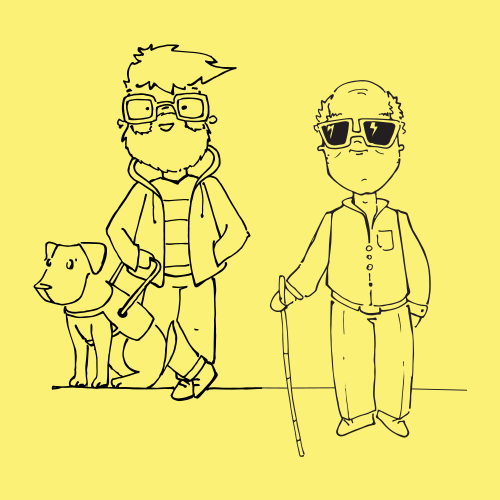
VISUAL: low vision & blindness
At home, everything is known to me. The position of the furniture and of all my things never changes. This helps my orientation and ensures my independence. Outside, however, everything changes rapidly. When I enter a place that is new to me, it is always a challenge. I need to learn and remember everything about that place at once and I need to focus on my orientation quite heavily. It can definitely get tiring and frustrating to be outdoors. It takes a lot of planning for me to go somewhere. I sometimes take public transportation like the train or the bus, but to do that by myself is a real challenge. If I want to go by train, for example, I need to announce this to the stations beforehand so that they can arrange proper guidance. Usually, I am accompanied by someone from my entourage, which makes it a lot more easy. Or we go by car together so that we have more freedom to choose where and when we want to go. Naturally I tend to stick to the places and people that I know. I usually go to the same shops and ride the same buses because it is more easy when I already know the way and the people on the way. I rarely go out by myself. When I want to go someplace new, there is usually someone to accompany me. Without proper guidance and multiple points of orientation from my environment, I would not be able to go out by myself at all.
Because I have a visual disability, I rely more on other sources of information than most people. Information through touch is very important. Tactile contrasts by way of ridge lines or texture tiles need to be very clearly defined and I need to be able to distinguish exactly which tactile differences hold meaning and which do not. The meaning also needs to be logical so that I can understand it correctly. These tactile points of information are guiding my way, so the communication cannot be interrupted or hindered by objects. I am relying on this information to guide me in a good and safe direction, not into fixed objects on the street or into traffic. If objects need to be places on the sidewalks, such as garbage bins or lights, then these should be placed on the same side and in a line so that there remains a clear and safe walkway.
Sounds are equally important. When I stop at a crossing, I am relying on the sonar signals to decide whether it is safe for me to cross or not. Ideally, this is combined with the necessary tactile information. The more information that is available to me, the more independently I can manoeuvre. For a great part, it ensures my freedom to move outdoors confidently.
Visual cues are very important to me as well! Often, people approach me as if I were completely blind, whereas I can still distinguish rough shapes, colours and shadows. There is a common misunderstanding that all blind people have completely lost their vision. Sometimes, persons are described as blind while they can still distinguish light and shapes up to some level. Once you take that into account, you can understand why the visual aspects of design and architecture are still important. Letters and numbers on information boards, name tags, information slips, etc. should be clearly defined by contrasting colors and large enough in ratio to the reading distance. Information boards should be in a logical place in the space, on eye level and their surfaces should not reflect the light. Also, information points like reception desks should be easily recognizably. Contrast is not only necessary for me to be able to read texts or recognize locations, but it is also important for safety reasons. Glass sliding doors, for example, are a safety hazard if they are not made visible by contrast strips or some other indication. Sometimes furniture can become a safety hazard, like protruding coat hooks or hot surfaces such as exposed light bulbs. Contrasting colors can help make unsafe elements stand out more.
New places and spaces take some time for me because I tend to lose my orientation. Contrast is very important in that aspect as well. Different colours or contrast in light and dark elements help make the features of a space recognisable to me. When entering smaller spaces, such as toilets or fitting rooms, the different elements of the space should be distinguishable. Entering a fitting room that is completely unicolour or in the same material, for example, sometimes spins my mind because I can’t tell where the floor ends and where the walls begin. The floor or the skirting boards should contrast with the walls so that I can estimate the size and the architecture of the space better. The furniture should contrast as well, like the chair and clothing hooks in a fitting room or the support handle in a public bathroom. When trying on clothes, it is difficult for me to recognise the silhouette of the clothes. I should be able to take a few steps back from the mirror, but most fitting rooms are too small for that. I should be able to move around comfortably, also when there is a person or guide dog accompanying me. It could also be interesting to have a dark and a light wall so that I can use them as contrasting backgrounds for light and dark colored clothes, respectively. I also require some coat hooks on either side of the fitting room because I like to divide my things into categories: my own clothes in the corner, clothes that I like on the left, clothes that I do not like on the right, etc. If I need to pile things on one chair or bench, I lose track of which is which. These are just a few things I often struggle with and for people without a visual disability these adaptations can come in handy as well!
Lighting is another important element of any space, outdoors as well as indoors. I prefer natural daylight, but when that is not possible, the artificial lighting in a space or building should be directed in such a way that it never shines directly or indirectly (though mirrors and smooth surfaces) into my eyes. When it does, this takes away all that I had left of my vision and leaves me completely helpless. For example, this often occurs in fitting rooms when I try to judge whether an outfit suits me or not. It is often either too dark or too bright in such small spaces. A lighting dimmer could offer a quick solution in those cases, especially because some visually disabled persons are light sensitive, while others are light demanding. For me, the main reason for staying indoors instead of enjoying myself outdoors, is my personal safety. Contrast, lighting, tactile and auditory information is paramount to my independence and confidence when leaving my home. In many ways, the design and architecture of the public space either enables or hinders me to enjoy and experience life the way I want to.