
CHILDREN: Babies & a children’s worldview
We all wonder from time to time what is going on in a child’s mind. The older we get, the less we remember what we felt like at that young age. Children have a different view and perspective on the world. They experience things differently and explore their environments in more direct ways, for example by touch. When it comes to young children and babies, certain adaptations need to be made to their environment to keep it safe and child-friendly, but also stimulating and convenient.
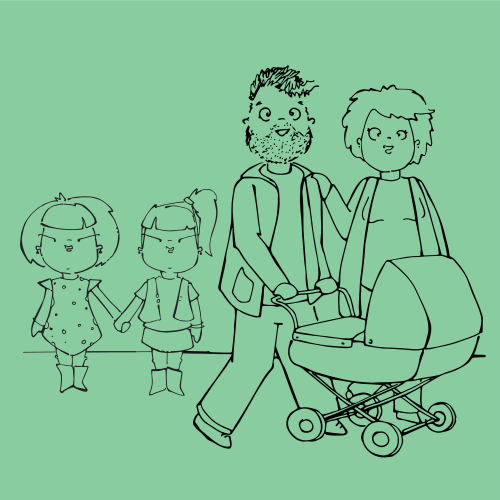
When it comes to children, the first thing on a parent’s mind is safety. For parents with babies, going outdoors is always a well planned and prepared trip. A lot of materials for the baby are taken along, such as clothes, diapers and baby food. Also the pram for the baby is taken along, of course, and so parents with babies need quite a lot of space to maneuver. For a baby, the world outside the safety of the home can be quite dangerous. The first apparent risk for a young child is traffic. Parents need enough space to walk safely with the pram next to the traffic without being too close to it. Ideally, there should at least be enough space for the pram and for two persons to walk next to each other and so that a person can also cross in the other direction easily. Whether public or personal transportation is used, parents should not feel limited or hindered by too little space or difficult thresholds.
When entering buildings and shops, parents with prams are often confronted with high thresholds or stairs on which they need to carry their material. Ramps or slopes are not always installed at entrances of shops or other buildings. Door openings and corridors should be wide enough to pass through easily. However, in the design of shops, for example, the possible presence of a pram is not usually taken into account. When a mother of a young child wishes to go shopping, at least she should be able to walk with the pram inside the store. When she wants to try on clothes, she should not feel hindered by a fitting room design that does not include the space that the pram takes up. If the fitting room is too small to fit both of them, this would mean that she needs to leave the pram with the child in it unguarded outside of the fitting space. A fitting room should offer enough space for the mother and the child, together with the pram and even with an accompanying family member or friend to help out. Because sometimes when it comes to children, two hands are just not enough.
Young children, who like to run around and explore the world by touch, should be guarded from unsafe situations as much as possible. Access to electrical appliances, electric sockets or light switches should be avoided. Also sharp edges, corners, hot surfaces and protruding objects should be avoided in the area that is available to a child’s touch. Glass doors, for example, are typically marked on the eye level of an adult person, but it is also dangerous for a child to run into it. So these markings should be on the eye level of children as well.
On the other hand, some objects are out of reach for children most of the time but should actually be more adapted to their lowered perspective. For example, children’s social contact with others is often hindered because tables, desks, windows, etc. are adapted to the height of adults. Children are less involved because of this. The way information is communicated is also adapted to adults as a target group. Written words, difficult jargon, complicated or abstract signs and pictograms are not understood by children. For children to understand this information, it should be made more accessible and simplified. The association between a space and its function is more easily understood it is explained by simple figures or pictures, rather than through words. For example, in a hospital the way to the dentist is shown through a sign with a drawing of a tooth. Or the different areas of a school, divided according to the age groups, are marked by a specific color and the way toward those areas are marked by signs of those same colors. For example, a child of the youngest age group could grasp more easily that he needs to follow the red arrow to reach his own class room that is also red. In a similar way, meaningful associations and references can be achieved via specific shapes, such as the triangle or square, or numbers. For young children, points of orientation in an unfamiliar environment are very important and are necessary to avoid distress and a feeling of being lost.
Taking young kids outside the house can be an exhausting experience for the children and their parents. So they need a place to sit down and rest from time to time. While doing so, they should be able to relax a bit, so too much stress and noisiness should be avoided. Environments that are too bright or too noisy can cause extra distress for the child and the parents. Spaces should stimulate the child in such a way that it improves their brain development and stimulates their curiosity, but it should not cause stress levels to rise. Whenever parents wish to take a break to sit down but their children wish to run around, they should be able to do that in a safe and playful environment, with enough visibility so that the parents can keep a close eye on their children without having to chase after them. So good visibility and good acoustics are paramount to a child-friendly environment that is both stimulating and stress-relieving. Because a happy child is more stimulated to try new things and to explore the world, while a playful and well-designed environment makes the parents feel more confident in their safety.