
MOBILITY: Pregnancy & mobility
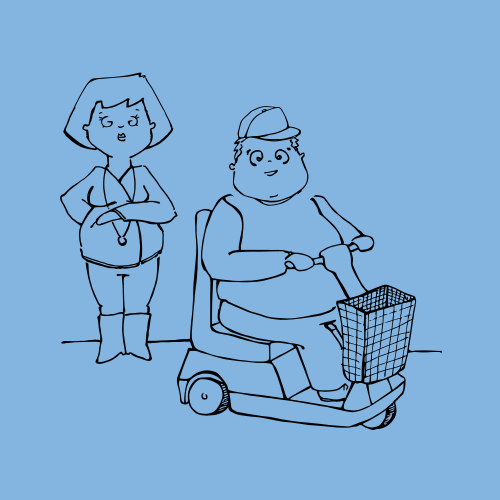
Although issues of inaccessibility are typically linked to inconveniences experienced by persons with mental of physical disabilities, problems with accessibility can also affect persons without a disability in their daily activities. Take persons with a larger body type for example. Every day, all of us are confronted with the idea of the ‘normal’ person. We are bombarded with images of the perfect looking, perfect size person in the street view, in advertisements, in the television industry. Larger and obese persons fall outside of the category of what a regular person is expected to look and behave like. As a result, their body types are not taken into account when products such as clothing, furniture, vehicles, and buildings and spaces are designed. In general, obesity is not a condition that is often featured in regular takes on accessibility. As a result, persons with a larger body type, such as obese persons but also pregnant women, can experience inconveniences when moving from their private surroundings into the public realm.
Yet obesity is becoming more and more visible in the public landscape and the presence of larger body types is becoming more widespread. The commercial market has already adapted to this wider variety of body types and more collections for larger persons are available today. In a similar manner, some brands have added a pregnancy collection or design exclusively for soon-to-be mothers. The design of spaces and furniture, in contrast, is still lagging behind on that development. For example, although a store might house a clothing collection for larger body types, the fitting rooms of that same store might not be adapted in such a way that a larger person can try on these clothes in a comfortable manner. In some stores, the larger sizes are located on another story than where the adapted fitting rooms are. Or the pregnancy collection is on the first floor, while the only means of getting there is up a long stairway. This makes trying on clothes a tiring and frustrating experience.
Door openings, corridors and stairs have often not been adapted to obesity or pregnancy. Larger persons and pregnant women need more space than usual and other means of moving up and down stories. As the falling hazard is often more present and dangerous for persons with obesity or pregnant women, the design of a space should limit dangerous steps and movements. Not only buildings need to be adapted in this way, but also public transportation may cause a recurring frustration. Easy access to public transportation such as trains and buses is often hindered by narrow door openings or dangerous and difficult steps up and down the bus or train. Inside, there is not a lot of space to maneuver.
There also needs to be ample opportunity to sit down comfortably on stable and robust furniture and to take breaks to rest from time to time. Public spaces, such as reception halls but also outside spaces, need to be equipped with enough comfortable resting places. Having to stand up for longer periods of time is uncomfortable and dangerous for persons of a larger body type. Other furniture, such as tables, can be adapted to larger persons as well. For example, a table that is designed with a recess on the sides, rather than simply rectangular, offers more space for the stomach area. For obese persons and pregnant women, this recess makes it more comfortable to sit at a table, or to fill in documents at an information desk. For pregnant women, it is easy to bump into straight edges or corners with their protruding belly and this should be avoided as much as possible. A recess improves social contact as well, because the distance between different persons at a table or across a desk is minimized.
Most important, accessibility today should ensure a reduction of the stigma that persons with a beyond average body type experience when they move outside their private surroundings. Obese persons and pregnant women should not be characterized only by what defines their physical state, whether that state is permanent or temporary. Inaccessible public space has the power to highlight specific bodily features in such a way that they disable the person. This in turn creates more stigma and more exclusion. In contrast, accessibility can break the vicious cycle by enabling rather than disabling.